

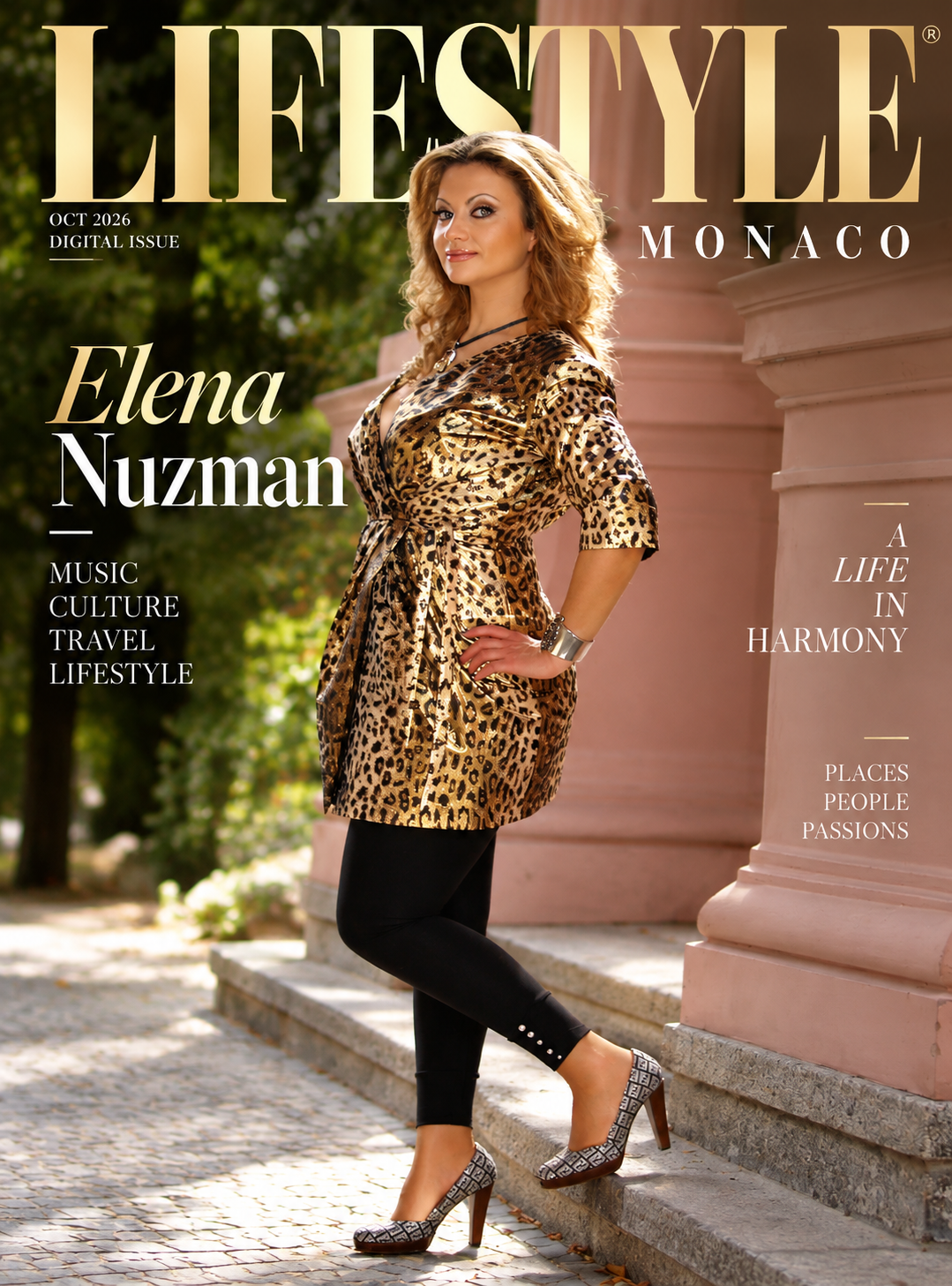
A Classical Musician Steps Into a Larger Stage
The concert hall has traditionally been one of the most respected homes of classical music. It offers concentration, acoustic precision and an audience prepared to listen closely.
Elena Nuzman knows that world intimately.
She also knows what it means to leave it.
Her career began with the piano and developed through intensive classical education, eventually leading to a master’s degree in concert piano from the Robert Schumann University of Music in Düsseldorf. Yet her artistic ambitions did not remain within the conventional boundaries of classical performance.
Nuzman discovered that her musical training could travel.
The concert hall was not the destination.
It was the foundation.
A Young Musician With an Unusual Ear
Born in Moldova into a family of professional musicians, Nuzman encountered music at an exceptionally young age. By two, she was already reproducing melodies on the piano by ear.
At seven, she entered a prestigious music Lyceum for gifted students and began formal classical training.
The discipline of those years shaped her technical abilities and her approach to performance. She learned the precision expected from a concert pianist and developed a sophisticated understanding of musical structure.
But classical education also gave her something less obvious: confidence in the language of music itself.
Once an artist understands musical structure deeply enough, the knowledge can be applied beyond the genre in which it was learned.
That is exactly what Nuzman eventually did.
Finding an Audience Outside Classical Music
Her musical journey later took her through several countries, including Russia, France, the United States, Israel and Canada. She eventually continued her education in Germany, completing her master’s degree in concert piano at the Robert Schumann University of Music in Düsseldorf.
Then her artistic path took an unexpected turn.
Nuzman entered a vocal competition and won first prize in the Rock-Pop category.
The victory introduced her to a different side of performance.
Instead of sitting behind the piano as her primary instrument, she could now stand at the center of the stage with her voice.
Her four-octave vocal range provided considerable versatility, but the bigger change was cultural. Rock and pop demanded a different kind of stage relationship.
The audience was not necessarily there for a formal interpretation of established repertoire.
They were there to experience a performer.
I Believe In You
That transition became particularly visible through her debut album, I Believe In You.
The album placed Nuzman in a contemporary setting, bringing together emotional songs with pop and rock influences. It entered the German Newcomer Charts and remained in the Top 10 for weeks.
For a musician with such a strong classical background, the move represented a meaningful expansion.
She was reaching listeners who might never attend a traditional piano recital.
Her interpretation of Whitesnake’s “Here I Go Again” became another important part of this chapter, demonstrating her ability to approach a well-known rock song while bringing her own musical identity to it.
Performances at large public events, including New Year’s Eve celebrations at Berlin’s Brandenburg Gate, placed her in environments where the scale and energy were very different from the traditional concert hall.
The audience had changed.
The performer had expanded.
The Power of Accessibility
One of the challenges facing classical music is accessibility.
The music itself can be extraordinarily emotional, but audiences who did not grow up around classical repertoire may sometimes feel distant from its conventions.
Nuzman’s work creates another entry point.
She understands the technical and historical depth of classical music, yet she is also comfortable presenting its emotional qualities through contemporary forms.
That does not mean simplifying the music.
It means changing the doorway through which listeners encounter it.
Bringing Romantic Music Into the Present
Liebestraum became an important example of this philosophy.
Inspired by Romantic-era music, the project explored the relationship between classical piano and contemporary songwriting. Nuzman treated the emotional qualities of the Romantic tradition as something living rather than historical.
The result connected classical inspiration with a modern audience.
The title track surpassed four million views on YouTube and received the IMPALA Silver Award.
The response suggested that listeners could connect with classical ideas even when those ideas were presented outside the traditional concert environment.
The Stage Becomes Wider
As Nuzman developed into a composer, the boundaries of her performance world expanded further.
Composition gave her greater control over the musical conversation. She could combine the skills of the pianist, vocalist and interpreter with her own ideas as a creator.
This is an important difference.
Performing can demonstrate mastery.
Composing demonstrates perspective.
Nuzman’s original work allows listeners to encounter not only the musician she has studied to become but also the artist she chooses to be.
My Piano And I
Her 2025 release My Piano And I brings these different identities together.
The album features celebrated songs, new compositions and English versions of some of her works. It reflects a musician who has travelled far from the conventional image of a concert pianist while remaining deeply connected to the instrument.
The piano is still present.
The voice is equally important.
The contemporary performer and classical musician are no longer separate.
They occupy the same stage.
Beyond the Traditional Definition of a Musician
The modern music landscape rewards artists who can communicate across platforms and audiences.
Nuzman’s career has naturally developed in that direction.
She can perform classical music with the authority of her training, interpret rock and pop with contemporary energy, and create original work as a composer.
That versatility has allowed her to reach different kinds of listeners without abandoning the musical principles that shaped her.
The journey is therefore not about leaving classical music behind.
It is about taking it somewhere else.
A Larger Stage Still Ahead
There is a certain irony in Elena Nuzman’s career.
She began in one of the most disciplined musical traditions in the world and eventually found herself performing in environments defined by greater freedom and unpredictability.
Yet the discipline never disappeared.
It became invisible beneath the performance.
That may be the secret of her crossover appeal.
Audiences see the vocalist, the rock performer and the contemporary artist.
Behind them is still the child who sat at a piano, the student who spent years mastering classical technique, and the concert pianist who learned to treat every note with purpose.
Elena Nuzman has gone beyond the concert hall without leaving it behind.
She has simply discovered that music can live in many rooms, on many stages and in many forms.
And she is willing to enter all of them.